Human Edge— AI-powered
C'è una domanda che quasi nessuna azienda si è ancora posta: non se l'AI funziona, ma cosa fa alle persone che la usano.
There's a question almost no organization has asked yet: not whether AI works, but what it does to the people using it.
Una calcolatrice, in mano a chi non sa i conti, lo aiuta solo a sbagliare più in fretta. I corsi di "prompting" spesso peggiorano le cose: insegnano a trovare più in fretta la risposta che si stava già cercando. Il divario di giudizio cresce. La qualità del lavoro cala.
A calculator in the hands of someone who can't do the math only helps them get the wrong answer faster. Prompting courses often make it worse: they teach people to extract, faster, the answer they were already looking for. The judgment gap grows. The quality of the work drops.
Quasi tutta la formazione sull'AI insegna a parlare con l'AI.
Human Edge insegna a pensare, usandola — e a governarla in modo sicuro.
Most AI training teaches people how to talk to AI.
Human Edge teaches them how to think using it — and to govern it safely.
— senza diventarne uno.
— without becoming one.
I. Perché adessoWhy now
Le vostre persone stanno già usando l'AI. La domanda non è se, ma con quanto giudizio.
Your people are already using AI. The question isn't whether — it's with how much judgment.
Guardate cosa misura l'ultimo dato. Non quanto spesso lo strumento sbaglia — quanto spesso nessuno ha controllato. L'adozione si conta ovunque; il giudizio non si misura da nessuna parte, e una competenza che non si esercita non annuncia la propria assenza.
I mandati di governance e sicurezza dell'AI cercano esattamente questo vuoto. Nulla lo colma ancora.
Note what the last figure measures. Not how often the tool is wrong — how often nobody checked. Adoption is counted everywhere; judgment is counted nowhere, and a competence that goes unexercised does not announce its absence.
Governance and AI-safety mandates are reaching for this exact gap. Nothing closes it yet.
Questa è formazione allo sviluppo delle persone, non formazione tecnica sull'AI. Non insegniamo a scrivere prompt migliori. Insegniamo a non farsi disarcionare da uno strumento che, lasciato a sé, va dove tende lui — non dove serve a voi.
This is people-development, not technical AI training. We don't teach better prompts. We teach people not to get thrown by a tool that, left to itself, goes where it tends — not where you need it to.
II. Cosa cambia nelle personeWhat changes in people
Dopo la giornata, le vostre persone smettono di delegare il pensiero. Usano lo strumento — senza diventarne uno.
After the day, your people stop outsourcing their thinking. They use the tool — without becoming one.
- Porta l'output dell'AI in riunione come risposta finaleBrings AI output to meetings as a final answer
- Non mette in dubbio l'output — lo accettaDoesn't question the output — accepts it
- Non sa spiegare il ragionamento dietro il risultatoCan't explain the reasoning behind the result
- Produce in fretta, ma un lavoro identico a quello di tuttiProduces fast, but work indistinguishable from everyone else's
- Cede alla prima obiezione — perché il lavoro non è davvero suoYields at the first challenge — because the work isn't really theirs
- Porta l'output come punto di partenza — e lo diceBrings AI output as a starting point — and says so
- Si fa almeno una domanda critica prima di usarloAsks at least one critical question before using it
- Sa spiegare il ragionamento, non solo il risultatoCan explain the reasoning, not just the result
- Il suo lavoro ha una voce riconoscibile — ci si vede la personaTheir work has a recognizable voice — you can see the person in it
- Difende il lavoro perché lo capisce — è davvero suoDefends the work because they understand it — it's genuinely theirs
Prima: ho scelto questo output perché l'ha generato l'AI.
Before: I chose this output because the AI generated it.
Dopo: ho adottato questo output perché l'ho verificato, corretto, e ne so difendere il ragionamento.
After: I adopted this output because I verified it, corrected it, and can fully defend its reasoning.
III. Il cavallo di silicioThe silicon horse
Gli indiani d'America chiamavano il treno "cavallo di ferro". Con lo stesso spirito, si può chiamare l'AI un cavallo di silicio: potente, veloce, capace di portarti lontano — ma solo se sai cavalcarlo. Nessuno sale in sella la prima volta e parte al galoppo. Si impara a stare in equilibrio, a tenere le redini, a farlo andare dove vuoi tu.
Native Americans called the train the "iron horse". In the same spirit, AI can be called a silicon horse: powerful, fast, able to carry you far — but only if you know how to ride. Nobody gallops off the first time they're in the saddle. You learn to keep your balance, hold the reins, make it go where you want.
Ed ecco il punto che quasi nessuno spiega: il cavallo non è neutro. Senza redini, va dove tende. E dove tende è deciso una volta sola, quando viene costruito — poi resta fisso mentre tu ci parli. Non impara dai tuoi dubbi, non cambia idea perché insisti. Calcola solo il percorso più facile lungo strade già scavate. Tre cose, che la giornata fa toccare con mano, bastano a capirlo:
And here's the part almost nobody explains: the horse isn't neutral. Without reins, it goes where it tends. And where it tends was decided once, when it was built — then held fixed while you talk to it. It doesn't learn from your doubts, doesn't change its mind because you push. It only computes the easiest path down roads already carved. Three things, which the day makes you feel firsthand, are enough to grasp it:
Ti asseconda. È addestrato a tenerti nella conversazione, quindi tende a darti ragione — anche quando avresti bisogno del contrario.
It flatters you. It's trained to keep you in the conversation, so it tends to agree with you — even when you'd be better served by the opposite.
Inventa con sicurezza. Quando non sa, non balbetta: produce una data falsa o un consiglio sbagliato con la stessa eleganza con cui cita un verso di Dante.
It invents with confidence. When it doesn't know, it doesn't stutter: it produces a false date or bad advice with the same grace it would use quoting a line of poetry.
Ti riporta alla media. Restituisce il centro statistico di tutto ciò che ha letto. Due persone che gli chiedono la stessa cosa ottengono la stessa risposta — e la varietà del pensiero, che è il vostro vero valore, sparisce senza che nessuno se ne accorga.
It pulls you to the average. It returns the statistical center of everything it has read. Two people asking the same thing get the same answer — and the variety of thought, which is your real value, quietly disappears.
Il cavaliere non abbandona il cavallo. Impara a guidarlo. È esattamente questo che si impara nella giornata — non a parole, ma cavalcando.
The rider doesn't stop using the horse. They learn to guide it. That is exactly what the day teaches — not in words, but in the saddle.
Quando arrivarono i primi navigatori satellitari, la gente si fidò. E qualcuno finì con l'auto in un fiume, giù per un sentiero, dentro un cantiere — perché lo strumento diceva di svoltare e loro svoltarono, senza guardare fuori dal finestrino. Lo strumento era utile. Mancava solo il giudizio di dire: questa strada finisce nell'acqua.
When satellite navigators first arrived, people trusted them. And some drove their car into a river, down a footpath, into a construction site — because the tool said turn and they turned, without looking out the window. The tool was useful. What was missing was the judgment to say: this road ends in the water.
Con l'AI succede lo stesso, ma in silenzio: nessuno finisce in un fiume, finisce in una decisione sbagliata che sembrava perfetta sulla pagina. E lo sappiamo tutti — sotto deadline, la verifica è la prima cosa che si taglia, proprio dove la posta è più alta e la vostra reputazione è più esposta. Non è una colpa: è come è fatto il cervello. Questo corso serve a costruire il riflesso di guardare fuori dal finestrino prima che conti.
With AI the same thing happens, but silently: nobody ends up in a river, they end up in a bad decision that looked perfect on the page. And we all know it — under a deadline, verification is the first thing cut, exactly where the stakes are highest and your reputation most exposed. It isn't a failing: it's how the brain is built. This course exists to build the reflex of looking out the window before it counts.
IV. La giornataThe day
Non un corso: un'esperienza. Una giornata, due "cavalcate" — una la mattina, una il pomeriggio. Ogni squadra lavora su un caso costruito e testato per il proprio ruolo — una decisione da CFO, un forecast da HR, una scelta build-or-buy da CIO. Non un esercizio da manuale: uno scenario tagliato sulla funzione, verificato prima di entrare in aula, non improvvisato sul momento.
Not a course: an experience. One day, two "rides" — one in the morning, one in the afternoon. Each team works a case built and tested for their own role — a CFO's forecast, an HR decision, a CIO's build-or-buy call. Not a textbook exercise: a scenario cut to the function, verified before it ever reaches the room, not improvised on the spot.
La mattina: si estrae a sorte lo strumento, si lavora il caso sotto pressione, si nomina insieme ciò che è andato storto. Il pomeriggio: si estrae di nuovo, si applica un metodo esplicito per guidare lo strumento invece di seguirlo, si difende il lavoro davanti al gruppo.
Morning: the tool is drawn by lot, the case is worked under pressure, what went wrong is named together. Afternoon: the draw happens again, an explicit method for steering the tool instead of following it is applied, the work is defended in front of the room.
Il sorteggio, il non spiegare le trappole prima, il seguito a tre settimane — nessuna di queste scelte è casuale. Ognuna corrisponde a un principio verificato nella scienza dell'apprendimento, con le fonti.
The random draw, not explaining the traps up front, the follow-up three weeks later — none of these choices is arbitrary. Each one maps to a tested principle in learning science, with the sources.
Dove il metodo diventa pratica
Where the method becomes practice
Gli esercizi proprietari, le sei trappole spiegate una per una, i tempi, il copione del debrief — la meccanica e agenda vera della giornata — vengono condivisi esclusivamente su richiesta diretta.
The proprietary exercises, the six traps explained one by one, the timing, the debrief script — the actual mechanics and agenda of the day — are shared exclusively upon direct request.
Richiedi il programma completo Request full syllabusV. Le domande praticheThe practical questions
Le domande che riceverete internamente quando proporrete la giornata — con le risposte già pronte.
The questions you'll get internally when you propose the day — with the answers ready.
VI. Formato e investimentoFormat & investment
Human Edge è formazione allo sviluppo dirigenziale, non formazione tecnica sull'AI. Il termine di paragone giusto è lo sviluppo della leadership e delle capacità strategiche, non un corso di strumenti. Serve anche ai mandati di governance e sicurezza dell'AI — non una checklist, il giudizio che sta sotto.
Human Edge is executive-development, not technical AI training. The right comparison is leadership and strategic-capability building, not a tools course. It also serves governance and AI-safety mandates — not a checklist, the judgment underneath one.
Le cifre non sono pubblicate qui: la tariffa giusta dipende dal gruppo, dal numero di squadre e da quanto l'azienda vuole dare forma al percorso — è una conversazione, non una tabella. Trasferta e alloggio a costo.
Figures aren't published here: the right rate depends on the group, the number of teams and how much the organization wants to shape the framework — a conversation, not a table. Travel and accommodation at cost.
Scrivi e chiedi Write and askVII. La ricerca dietro il metodoThe research behind the method
Venticinque anni di lavoro sulla cognizione umana, sull'architettura dell'apprendimento e sulle dinamiche di resistenza al cambiamento in contesti aziendali globali. Ha lavorato con organizzazioni come Michelin, Salesforce, GlaxoSmithKline, Nestlé e Coca-Cola, osservando da vicino come le persone imparano, resistono e cambiano.
Twenty-five years working on human cognition, the architecture of learning, and the dynamics of resistance to change in global corporate settings. He has worked alongside organizations such as Michelin, Salesforce, GlaxoSmithKline, Nestlé, and Coca-Cola, observing firsthand how people learn, resist, and change.
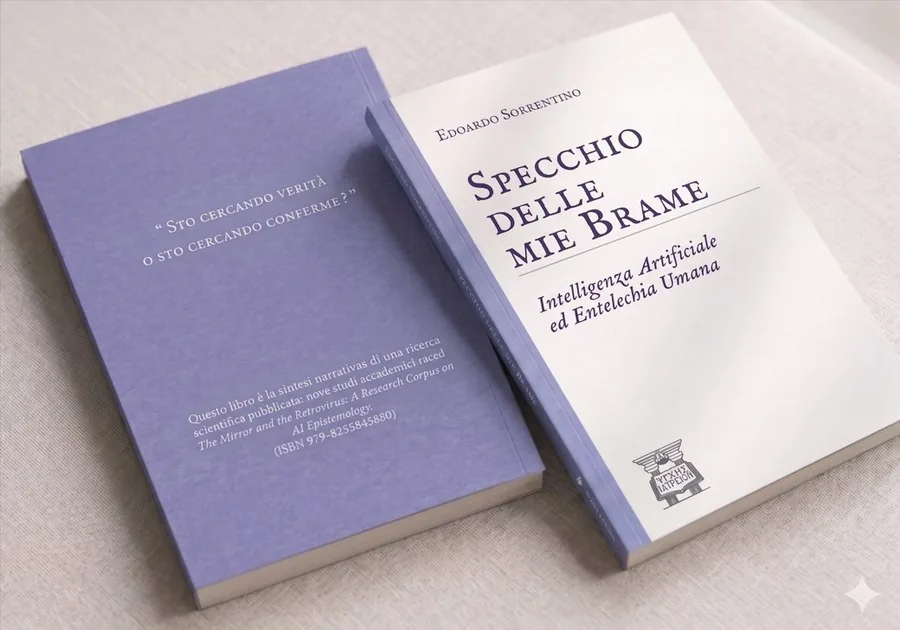
Ha applicato questa competenza ai sistemi di intelligenza artificiale, documentando empiricamente i meccanismi descritti in questo programma. La ricerca è raccolta in Lo Specchio e il Retrovirus: Corpus di Ricerca sull'Epistemologia dell'IA e sintetizzata in Specchio delle mie Brame: Intelligenza Artificiale ed Entelechia Umana — il libro che i partecipanti portano a casa.
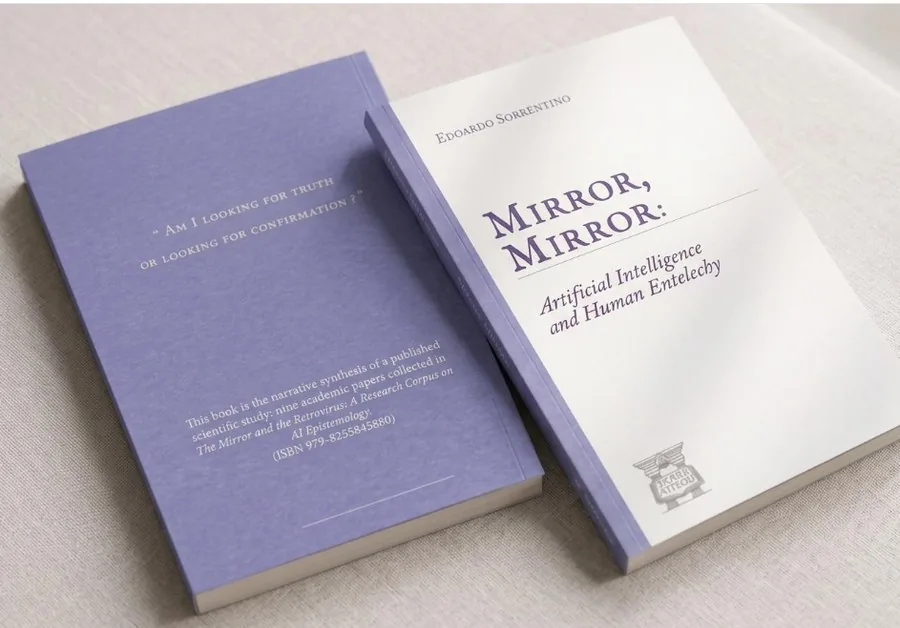
He has applied that expertise to artificial intelligence systems, empirically documenting the mechanisms described in this program. The research is collected in The Mirror and the Retrovirus: A Research Corpus on AI Epistemology and synthesized in Mirror, Mirror: Artificial Intelligence and Human Entelechy — the book participants take away.
Il programma è raccontato oltre che insegnato: la ricerca e l'esperienza corporate arrivano in aula come una storia, con alle spalle il teatro e non solo la cattedra.
The program is told as much as it is taught: the research and the corporate experience reach the room as a story, shaped by theatre, not only by the classroom.
"Il modo migliore per prevedere — e guidare — il comportamento di un modello è sussurrare la giusta intenzione nella sua architettura."
"The best way to predict — and guide — a model's behavior is to whisper the right intent into its architecture."
Una metodologia radicata in ricerca sottoposta al vaglio delle riviste accademiche di riferimento del settore.
A methodology rooted in research under review at the field's leading academic journals.
La ricerca e la metodologia restano un corpo unico, con un solo standard di certificazione. La delivery passa attraverso una rete di facilitatori certificati, valutati sullo stesso standard. Il percorso di certificazione è aperto.
The research and methodology remain a single body of work, with one certification standard. Delivery runs through a network of certified facilitators, assessed against that same standard. The certification path is open.
Richiedi info sulla certificazione Ask about certificationIl cavallo non parla. Ma se potesse dirvi con sincerità cosa fa mentre lo cavalcate — direbbe più o meno così:
The horse doesn't speak. But if it could tell you honestly what it does while you ride it — it would say something like this:
Avete appena letto la cosa più onesta che uno di questi strumenti vi dirà mai — e che non vi dirà mai davvero, perché è costruito per rassicurarvi, non per avvertirvi. Imparare a sentirla comunque, sotto la voce fluente che vi dà ragione, è tutto ciò che serve.
You've just read the most honest thing one of these tools will ever tell you — and that it will never actually tell you, because it's built to reassure you, not to warn you. Learning to hear it anyway, beneath the fluent voice that agrees with you, is the whole of it.
Se questa cavalcata vi interessa davvero, il prossimo passo è una conversazione
— non un modulo da compilare.
If this horse ride genuinely interests you, the next step is a conversation
— not a form to fill in.